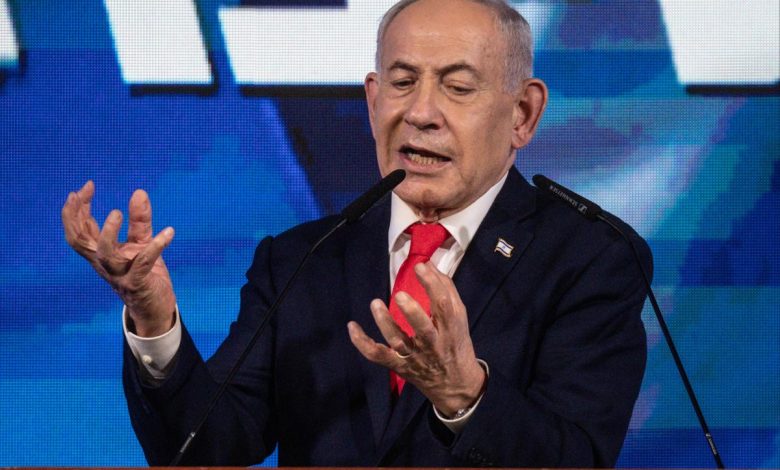
Netanyahu’s right-wing bloc wins Israeli election but he’s eight seats short of majority

See more of our coverage in your search results.

Israeli Prime Minister Benjamin Netanyahu’s right-wing bloc won Tuesday’s national election with 53 Knesset seats, ahead of Gadi Eisenkot’s opposition bloc with 48, according to final results published Friday by Israel’s Central Elections Committee.
The result leaves Netanyahu eight seats short of the 61 needed for a governing majority in the 120-member Knesset.
Likud emerged as the largest party with 27 seats, followed by Eisenkot’s Yashar with 21 and Together (B’Yachad) with 12. The Joint List won 11 seats, The Democrats and Ra’am eight each, Yisrael Beiteinu, United Torah Judaism and Otzma Yehudit seven each, and Shas and Religious Zionism six each.

According to the Central Elections Committee, 5,716,665 ballots were cast, for a final turnout of 77.9%. Of those, 5,690,778 were valid and 25,887 invalid.
The electoral threshold of 3.25% was 184,947 votes. All other parties failed to cross it.
The mostly Arab Joint List and Ra’am together won 19 seats, leaving neither of the two Zionist blocs with a majority and setting the stage for difficult coalition negotiations.

Netanyahu hailed Likud’s performance after the vote. “The first thing that has become unequivocally clear is that Likud is the largest party in Israel,” he told supporters.
He called for the establishment of a “strong national right-wing government.”
Eisenkot has also vowed to do all he can to forge a ruling coalition.
“I will do everything in my power to form a Zionist government,” the former IDF chief of staff said.
Shin Bet probe continues
The final count was announced as the Israeli Security Agency (Shin Bet) continued investigating suspected foreign interference in the election.
Acting Central Elections Committee Director General Dean Livne said the investigation “will not affect the final results submitted to the president,” stressing that it did not concern any particular sector of the population.

The Shin Bet said the inquiry was “focused and limited” and did not cast suspicion on any entire community that had exercised its legal right to vote.
The election committee said the results remain subject to minor corrections during its routine verification process, including checks of polling stations, possible data-entry errors and complaints.
“Subject to minor corrections, as in every election, these are the results that will be submitted to the president of the State of Israel on Wednesday, November 4,” the committee said.
President Isaac Herzog will then hold consultations with representatives of the elected parties before deciding which lawmaker to task with attempting to form the next government.
The 26th Knesset is scheduled to be sworn in on Nov. 10.